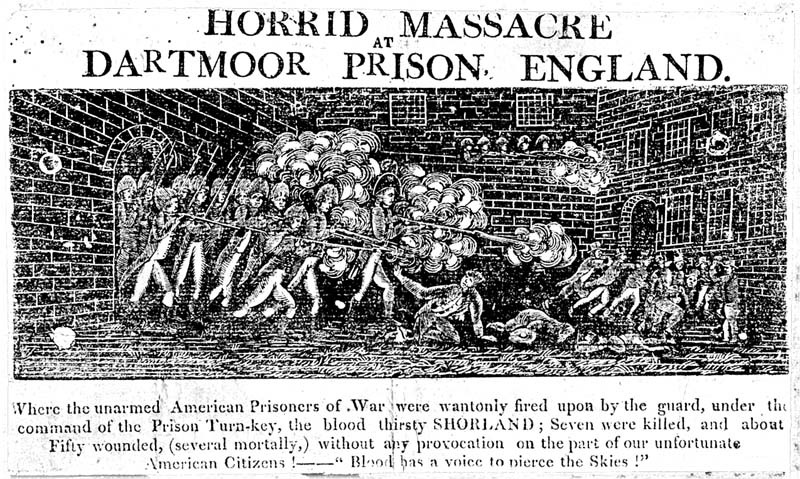
 |
 original documents original documents |
FO 371/38676 Admiralty Office April 10 1815 Sir My Lords Commissioners of the Admiralty think it right to acquaint Lord Castelreagh that on the evening of the 6 th instant a very alarming Riot broke out among the American Prisoners of War confined at Dartmoor, the Rioters it appeared endeavoured to overpower the Guard to force the Prison and had actually seized the Arms of some of the Soldiers, and made a Breach in the Walls of the Depot, when the Guard found itself obliged to have recourse to their fire arms and five of the Rioters were killed, and thirty four wounded [page2] after which the tumult subsided and the Depot was placed in a state of tranquillity and security. Admiral Sir J. T. Duckworth Commander in Chief at Plymouth, having received information of this unfortunate event, lost no time in directing Rear Admiral Sir Josias Rowley Bart. & KCB and Captain Schomberg the two senior officers at that Port, to proceed to Dartmoor, and to enquire into the circumstances: Those officers accordingly repaired to the Depot, where they found on examination of the officers of the Depot, and [3] all the American Prisoners who were called before them that the circumstances of the Riot were as before stated, but that no cause could be assigned for the conduct of the Prisoners but their impatience to be released; and the Americans unanimously declared, that their complaint of delay was not against the British Government, but against their own, which ought to have sent means for their early conveyance home, and in replies to distinct questions to that effect they declared that they had no [4] other ground of complaint whatsoever:- Their Lordships think it right to add that on the 15 th of last Month, they directed the Transport Board to take measures for carrying the Article of the Treaty for the release of American Prisoners into effect, and again on the 30 th ultimo, I was directed to write to known what steps had been taken under these directions, and the Transport Board answered in their letter of the next day, that they had communicated with Mr Beasely, the American Agent, on the subject who had acquainted them, that [5] he had already promised some Transports and was employed in procuring others for the conveyance of the Prisoners to America :- It will be for Lord Castelreagh to judge whether it may not be proper to make a communication on this subject to the American Government I am [signed] J W Croker
[143]We the Undersigned Commissioners appointed on behalf of our respective Governments to enquire into and report upon the unfortunate occurrence of the 6 th of April last at Dartmoor Prison, having carefully perused the Proceedings of the Several Courts of Inquiry instituted immediately after that board, by the order of Admiral Sir John T Duckworth, and Major General Brown respectively, as well as the deposition taken at the Coroner’s Inquest upon the bodies of the Prisoners, who lost their lives upon that melancholy occasion (upon which inquests the jury found a vindication of justifiable homicide) proceeded immediately to the examination upon oath, in the presence of one or more of the Magistrates in the vicinity, of all the [143/2] Witnesses, both American and English, who offered themselves for that purpose, on who could be discovered as likely to afford any material Information on the subject; as well those who had been previously examined before the Coroner, as otherwise, to the number in the whole of above 80 – We further procured to a minute examination of the prison for the purpose of clearing up some points which upon the evidence alone were scarcely intelligible, obtaining from the prisoners, and from the officers of the Depot, all the necessary of assistance, and explanation – And premising , that we have been from necessity compelled to draw many of our own conclusions from statements and evidence highly contradictory, We do now make upon the whole of the proceedings the following report. [144]During the period which has elapsed since the arrival in this country, of the Accounts of the Ratification of the Treaty of Ghent, and increased degree of restlessness, and impatience of confinement, appears to have prevailed amongst the American prisoners at Dartmoor; which though not exhibited in the shape of any violent excess, has been principally indicated by threats of breaking out if not soon released. On the 4 th of this month in particular, only two days previous to the events the subject of this Inquiry, a large body of the prisoners rushed into the market Square, from whence by, the Regulations of the Prison they are excluded, demanding bread, instead of bisket, which had on that day been issued by the officers of the Depot, their demands however having then almost [144/2] immediately been compiled with, they returned to their own yards, and the employments of force on that occasion became unnecessary. On the evening of the 6 th, about 6 o’clock, It was clearly proved to us, that a breach or hole had been made in one of the prison walls, sufficient for a full sized man to pass, and that others had been commenced in the course of the day, near the same ? though never completed. That a number of the prisoners were over the railing erected to prevent them from communicating with the sentinals on the walls, which was of course forbidden by the regulations of the prison, and that in the space between the railing and those walls, they were tearing up pieces of turf, and wantonly felling each other in a noisy and disorderly manner, That a much more considerable number, of the prisoners was collected together at that [145] time, in one of their yards where the breach was effected, and that although such collection of prisoners was not unusual at other times (the gambling tables being commonly kept in that part of the yard) that when connected with the circumstance of the breach, and the time of the day,(which was after the horn, the signal for the prisoners to retire to their respective prisons had ceased to sound) It became a natural and just ground of alarm, to those who had charge of the depot. It was also in evidence that in the building formerly the Petty officers prison, but now the Guard Barrack, which stood in the yard to which the hole in the wall would serve as a communication, a part of the arms of the guards who were off duty were usually kept in the racks; and though there was no evidence, that this was in any respect the motive which induced the prisoners to make the opening in the wall, or even that they were acquainted with the facts [145/2] naturally became at least a further cause for suspicion and alarm, and an additional reason for ? :- Upon these grounds Capt. Shortland appears to us to have been justified in giving the orders which about this time he seems to have given, to sound the alarm bell, the usual signal for collecting the officers of the depot, and putting the Military on the alert. However reasonable and justifiable this was as a measure of precaution, the effects produced thereby in prisons, but which could not have been intended, were most unfortunate, and deeply to be regretted. A considerable number of the prisoners in the yards where no disturbance existed before, and who were either asleep in their respective prisons, or quietly retiring as usual towards them, immediately upon the sound of the bell, rushed back from curiosity (as it appears) towards the later that time the crowd had assembled; and many who were at the time absent from their yards, were also from the plan prison compelled in order to reach their own homes, to pass by the same spot and thus, that which was merely a measure of precaution, in its operation increased the evil it was intended to prevent:- Almost at the same time instant that the alarm bell rang ( but whether before or subsequently is upon the evidence doubtful, the Capt. Shortland states it positively as one of his further reasons for causing it to bring some one or more of the Prisoners broke [146] broke the iron chain, which was the only fastening of No.1 Gate, leading into the Market Square, by means of an iron bar, to a very considerable number of prisoners immediately rushed towards that gate, and many of then began to press forward, as fast as the opening would permit, into the Square. There was no direct proof before us, of previous concert or purpose or preparation on the part of the prisoners, & no evidence of their intention or disposition, to effect their escape on this occasion, excepting that which arose by inference from the whole of the above detailed circumstances connected together. The natural and almost irresistible influence to be drawn however from the conduct of the Prisoners, by Capt. Shortland, & the Military was, that an intention on the part of the prisoners to escape was on the point of being carried into execution, and it was at least certain that they were by force passing beyond the limits prescribed to them, at a time when they ought to have been quietly going in for the night. What was also in evidence that the outer Gates of the Market Square were usually opened about this time, to let the bread wagon pass & re-pass to the store, although at the period in question, they were in fact closed [146/2] Under these circumstance & with the impressions necessarily operating upon his mind & the knowledge that if the prisoners once penetrated through the square, the power of escape was almost to a certainty afforded to them, if they should be so disposed, Capt Shortland in the first instance proceeded down the Square towards the prisoners, having ordered a part of the difficent Guards to the number of about 50 only at first (though they were encreased afterwards) to follow him. For some time, both he, & Dr Magrath, endeavoured by quiet means, & persuasion, to induce the prisoners to retire to their own yards; explaining to them the fatal consequences which must ensue if they refused; as the military would in that case he necessarily compelled to employ force. The Guard was by this time formed in the rear of Captain Shortland, about two thirds of the way down the Square, the latter, is about 100 yards broad, & the Guards extended nearly all across – Capt. Shortland finding that persuasion was in vain & that although some were induced by it to make an effort to retire; others pursued on in considerable numbers, at last ordered about 15 file of the Guard, nearly in [147] in front of the Gate which had been forced, to charge the prisoners back to their own yards. The prisoners were in some places so near the military, that one of the soldiers states, he could not come fairly down to the charge; & the military were unwilling to act as against an enemy – Some of the prisoners who were unwilling, & reluctant to retire; & some pushing & struggling ensued between the parties, arising partly from intention, but mainly from the pressure of those behind preventing those in front from getting back. After some little time however this charge appears to have been so far effective, & that with little or no injury to the prisoners as to have driven them for the most part quite down out of the Square with the exception of a small number who continued their assistance against No.1 Gate A great crowd still remained collected after this in the passage between the Square & the prisoner yards, and in the part of those yards in the vicinity of the Gates. This assemblage, still refused to withdraw and according to most of the English witnesses & some of the Americans was making a noise, hallooing, insulting & provoking [147/2] and daring the military to fire & according to the evidence of several of the soldiers and some others was pelting the military with large stones, by which some of them were actually struck. This Circumstance however is denied by many of the American witnesses & some of the English, upon having the Question put to them stated that they saw no stones thrown previous to the firing although their situation at the time was such as to enable them to see most of the other proceeding in the Square. Under these circumstances the firing commenced. With regard to any order having been given to fire the evidence is very contradictory: Several of the Americans swear positively that Captain Shortland gave that order, but the manner in which from the confusion of the moment they describe this part of the transaction, is so different in its details, that it is very difficult to reconcile their testimony. Many of the soldiers & other English witnesses heard the word given by some one but no one of them can swear it was by Captain Shortland or by any one in particular & some (amongst whom is the officer commanding the Guards) thinks, if Captain Shortland had given such an order that they must have heard it, which they did not. In addition to this, Captain Shortland denies the fact & from the situation in which he appears to have been placed at [148] the time even according to American witnesses, in front of the soldiers, That may appear somewhat improbable that he should have given such an order – But however it may remain a matter of doubt, whether the firing first began in the Square by order, or was a spontaneous act of the soldiers themselves, That seemed clear. That it was continued, and answered, both there & elsewhere, without orders, & that on the platforms & in several places about the prison, It was certainly commenced without any authority. The fact that an order having been given at first, provided the firing was under the existing circumstances justifiable; does not appear very material in any other point of view, than as having a want of self possession & discipline in the troops, if they should have fires without order. With regard to the above most important consideration, of whether the firing was justifiable, or not, we are of opinion, under all the circumstances of the case from the apprehension which the soldiers might fairly entertain owing to the number & conduct of the prisoners, that this firing [148/2] a certain extent was justifiable in a military point of view, in order to intimidate the prisoners, & compel them thereby to desist from all Acts of Violence, & to retire as they were ordered from a situation in which the responsibility of the Agent, & the military, and not permit them with safety to remain. From the fact of the crowd being so close, & the firing at first being attended with very little injury it appears probable that a large proportion of the muskets were as stated by one or two of the witnesses, levelled over the heads of the prisoners, a circumstance in some respects to be lamented, as that induced them to cry out “Blank cartridges”, and merely ?, & encouraged them to renew their insults to the soldiers, which produced a prepetition of the firing in a manner much more destructive The firing in the Square having continued for some time, by which several of the prisoners sustained injuries, the greater part of them appear to have been running back with the utmost confusion & precipitation to their respective prisons, and the cause for further firing seems at this period to have [149] ceased. That appears accordingly that Captain Shortland was in the market place, exerting himself, & giving orders to that effect & that Lieut. Fortye had succeeded in stopping the fire on his part of the yard. Under these circumstances, it is very difficult to find any justification for the further renewal & continuance of the firing, which certainly took place both in the prison yards, & elsewhere; though we have some evidence of subsequent provocation given to the military, & resistance to the turnkeys in shutting the prisons, & of stones being thrown out, from within the prison doors. The subsequent firing appears, rather to have arisen from a state of individual frustration & exasperation on the part of the soldiers who followed the prisoners into their yards and from the absence of nearly all the officers who might have restrained it, as well as from the great difficulty of putting an end to a firing, when once commenced under [149/2] Captain Shortland was from this time busily occupied with the turnkey’s in the Square, ? & taking care of the wounded. Ensign White remained with his guard at the Breach & Lt’s A? & Fortye the only other subalterns known to have been present continued in the Square with the main bodies of their respective guards. The time of the day, which was the officers dinner hour, will in some measure explain this, as it caused the absence of every officer from [150]the prison whose presence was not indispensable there – And this circumstance which has been ? as an argument to prove the intention of the prisoners to take this opportunity to escape, tended to increase the confusion, and to ? those greater exertions being made, which might perhaps have obviated at least a portion of the mischief which ensued. – At the same time that the firing was going on in the Square, a cross fire was also kept up from several of the platforms of the walls round the prison, where the sentries stand, by straggling parties of soldiers, who ran up there for that purpose. As far as this fire was directed to disperse the men assembled round the breach, for which purpose it was most effectual that seems to stand upon [150/2] the same ground as that in the first instance in the Square But that part which it is positively sworn was directed against straggling parties of prisoners running about the yards and endeavouring to enter the few doors which the turnkeys according to their usual practice had left open, does seem, as stated, to have been wholly without object or excuse and to have been a ? attack upon the lives of defenceless and at that time unoffending individuals In the ? as ? in more severe terms, we must remark upon what was proved as to the firing into the doorways of the prisons, more particularly into that of No.3 prison at a time when the men were in crowds at the entrance – From the position of the prison and of the door, and from the marks of the balls which were [151]pointed out to us as well as from the evidence, It was clear this firing must have proceeded from soldiers a very few feet from the doorway – And though it was certainly sworn, that the prisoners were at the time of part of this firing at least, continuing to insult and occasionally to throw stones at the soldiers, and that they were standing in the way of and impeding the turnkeys who was there for the purpose of closing the door, yet still there was nothing stated, which could in our view at all justify such excessively harsh and severe treatment of helpless and unarmed prisoners, when all idea of escape was at an end [151/2]Under these ? we used every endeavour to ascertain if there was the least prospect of identifying any of the soldiers who had been guilty of the particular outrages here alluded to, on of tracing any particular death at that time to the firing of any particular individual but without success and all hopes of bringing the offenders to punishment should seem to be at an end. In conclusion, we the undersigned, have only to add, that whilst we lament as we do most deeply the unfortunate transaction which has been the subject of this Inquiry, we find ourselves wholly unable to suggest steps to be taken as to those parts of that, which seem most [152] most to call for redress, and punishment Signed Francis Seymour Larpent Charles King Plymouth April 26 th 1815 |